
Painting a Kid’s Room: From Nursery to Whatever Comes Next
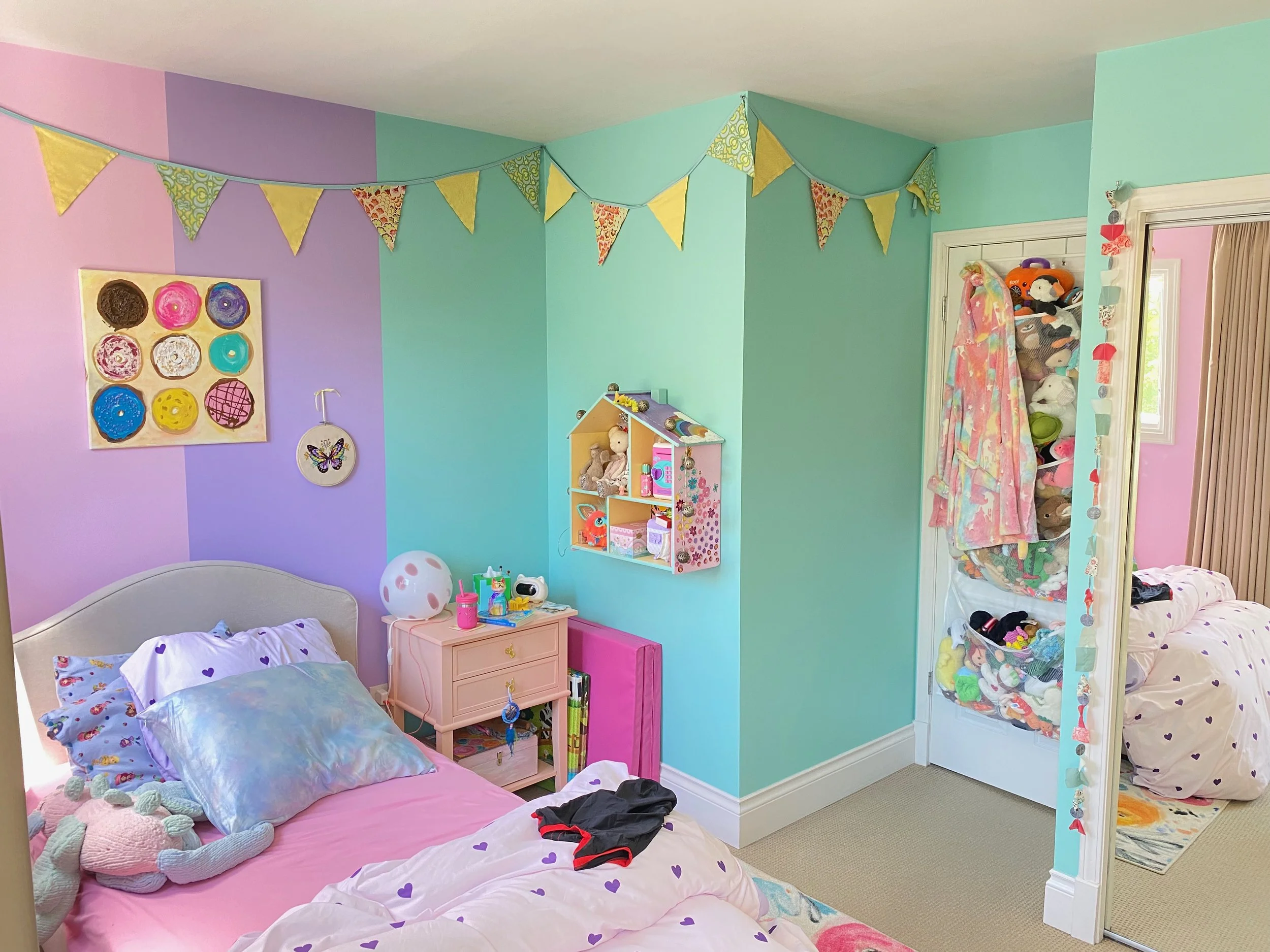
Colourful child’s bedroom painted in turquoise, lavender and pink with multiple feature walls.
A child’s bedroom is one of the few rooms in a home that is almost guaranteed to keep changing.
It might begin as a nursery, designed before its occupant has even arrived. A few years later there are favourite colours, animals, planets, princesses, dinosaurs or whatever else has taken over their imagination. Eventually, that child has very definite ideas of their own.
Paint is particularly good for this kind of room because it doesn’t have to be permanent. A bedroom can change as the kid does.
And there are a lot more possibilities than simply choosing one colour and painting all four walls.
Starting With the Nursery
When preparing a nursery, people often gravitate toward soft colours — warm whites, pale greens, muted pinks, blues and neutrals. There’s nothing wrong with that, but a nursery doesn’t necessarily need to look like a nursery catalogue.
A coloured ceiling, a feature wall, a painted arch behind the crib, or two coordinating colours can give the room much more character without making it busy.
Paint choice can matter here as well. Low-odour, zero-VOC and zero-emissions paints are available for people who want to minimize paint fumes and emissions in a nursery or newly occupied room.
“Low VOC,” “zero VOC,” “low odour” and “zero emissions” don’t all mean exactly the same thing, so we can help choose a product based on what matters most for the particular room.
Then They Develop Opinions
This is where children’s bedrooms get more interesting.
Once a child starts choosing their own colours, the answer doesn’t have to be either “no” or four walls of radioactive purple.
A favourite colour can be used in dozens of ways.
A single feature wall is the simplest. But you can also use broad horizontal bands, vertical stripes, colour blocking, geometric shapes, painted arches or a darker colour on the lower half of the wall.
Doors, closets, bookshelves and other built-ins can become accents too.
And don’t forget the ceiling. A child’s bedroom is one of the few places where a blue, pink, yellow or even very dark ceiling can make perfect sense.
Sometimes the slightly strange colour combination a kid comes up with turns out to be much more interesting than the tasteful adult version.
[PHOTO: colourful turquoise, lavender and pink bedroom]
There’s no rule saying a bedroom has to be one colour. In this room, several strong colours work together because they’re given their own areas rather than being mixed everywhere at once.
Paint That Actually Does Something
There are also specialty paints that can turn part of the room into something interactive.
Chalkboard paint can create a drawing surface on a wall, door or smaller panel.
Magnetic paint contains iron particles that allow magnets to stick to the painted surface. A normal wall colour can usually be painted over it, so the magnetic wall doesn’t have to look different from the rest of the room.
And yes, there is glow-in-the-dark paint.
It can be used for stars on a ceiling, constellations, planets, shapes, lettering or small details that disappear during the day and show up when the lights go out.
For a kid, that is considerably more exciting than discussing the relative merits of eggshell and matte.
Choosing a Paint Finish for a Kid’s Room
The finish — or sheen — affects both how the paint looks and how easily it can be cleaned.
In general, the shinier a paint is, the more resistant it is to washing and repeated cleaning. Satin and eggshell finishes have traditionally been popular for children’s rooms for that reason.
Modern paints have changed things somewhat. Some high-quality matte and low-sheen paints are now surprisingly washable, so you don’t necessarily need shiny walls simply because there is a child living between them.
Higher sheen also reflects more light and tends to show bumps, patches and imperfections more clearly.
For many kids’ bedrooms, eggshell is still a very practical middle ground: enough durability for fingerprints and marks without looking glossy.
Trim, doors and baseboards are generally painted in a more durable finish such as satin or semi-gloss.
Small Rooms Don’t Have to Be White
This is particularly relevant in Vancouver, where children’s bedrooms are often not enormous.
There’s a persistent idea that small rooms need to be painted white or very pale colours to make them look bigger. Sometimes that works. But a small room can also benefit from embracing its size.
A deeper colour can make a little bedroom feel cosy and deliberate. Painting a wall and ceiling the same colour can soften awkward angles. Vertical colour blocks can emphasize height. A contrasting end wall can change the apparent proportions of a long narrow room.
Older Vancouver homes also tend to have architectural details that newer homes don’t — picture rails, sloped ceilings, unusual alcoves, built-in cupboards and interesting trim. Instead of treating those features as obstacles, paint can emphasize them.
A Room That Can Keep Changing
One advantage of using paint rather than committing everything to wallpaper, permanent fixtures or an elaborate theme is that the room can evolve fairly easily.
The dinosaur years end.
So do the princess years.
Then apparently everything needs to be black.
Paint can keep up.
A child’s bedroom doesn’t need to be sophisticated enough for the adults in the house. It needs to belong to the person who sleeps there.
And because paint is relatively easy to change, it’s a good place to experiment a little.
Thinking about painting a nursery or kid’s bedroom in Vancouver?
Port City Painting can help with everything from colour placement and feature walls to washable finishes, specialty paints, and low-odour or zero-emission options.
Vancouver’s Interiors Finally Get Their Colour Back
After what seems like an eternity of slightly off-whites dominating Vancouver interiors, the first rays of colour are finally breaking through. With a wide range of hues forecast for the coming year, there’s something to suit every mood and every space.
Many Vancouver homes are open-concept, making the use of a single colour throughout the main living areas common. Livability and comfort remain key, so this year’s soft taupes and “greiges” are smart choices — subtle yet full of character. We recently completed a home in Mount Pleasant that used a beautiful greige — a complex tone that lives between grey and beige. It shifts gracefully with the light, staying balanced whether under the sun, clouds, or warm evening lamps.
Bedrooms are a perfect place to explore deeper, more personal colours. For adult spaces, muted greens, olive, sage, soft terracotta, and clay tones are timeless yet contemporary. Even the early-2000s “feature wall” is making a comeback — but with more sophistication. In a Cedar Cottage master bedroom, we used a soft sage on three walls and a slightly darker shade on the fourth, adding subtle depth without dominating the room. And when your kids start to care about colour, things can get exciting fast. We recently painted a 10-year-old girl’s room in East Vancouver a punchy lavender with a turquoise accent wall — she was absolutely thrilled.
A common misconception is that white paint makes small rooms feel larger. While that can work with lots of natural light, in dimmer spaces white often feels sterile and utilitarian. Instead, small rooms are the perfect opportunity to lean into rich, dramatic tones. Deep blues, burgundy, plum, and chocolatey browns can make a small office feel cozy and intentional. And don’t forget the powder room — a space often treated as an afterthought. We recently painted one in Riley Park–Little Mountain a deep charcoal grey with crisp white trim; paired with ornate silver frames, it became an oasis of vintage Hollywood glamour.
As Vancouver’s design sensibility matures, we’re seeing homeowners embrace more colour, texture, and personality — without sacrificing the city’s signature calm and livable aesthetic. Whether you start with a subtle greige or dive into something bold and moody, the best colour is the one that makes your home feel more like you. After all, walls aren’t just backdrops — they’re the atmosphere you live in every day.
How to Save Money When Hiring a Professional Painter in Vancouver
Painting is one of the most cost-effective ways to transform your home. Whether you live in Mount Pleasant, Kitsilano, or Cedar Cottage, hiring a professional painter ensures quality results, but there are a few simple steps you can take to make the process even more affordable. By preparing your home ahead of time, you’ll save both time and money while helping your painting project run smoothly.
Clear the Space for Faster, More Affordable Painting
The more accessible your walls are, the faster our team can work. Ideally, leaving at least four feet of space around each wall allows us to paint efficiently and with precision. Smaller items like side tables, lamps, garbage bins, and rolled-up carpets can be removed ahead of time. Larger items such as couches, cabinets, or bookshelves can be pulled toward the centre of the room, where we’ll cover them completely for protection.
If you’re able to remove your TV from the wall, that’s a bonus—but if not, don’t worry. We’ll safely enclose it in protective plastic before painting begins. For homeowners in Cedar Cottage, Kitsilano, and Mount Pleasant, this prep work can make your project faster and more budget-friendly.
Pay Attention to the Details
At Port City Painting, we handle the small details that make a big difference. We routinely remove wall attachments like blinds, curtain rods, switch plates, towel bars, and shelving. This saves time, prevents uneven brush marks, and ensures a cleaner, more professional finish.
If you’re comfortable taking these items down yourself before we arrive, it allows us to focus entirely on painting—helping you save on non-painting labor costs. Many Vancouver homeowners in Mount Pleasant, Kitsilano, and Cedar Cottage appreciate this simple step for keeping their projects on budget.
A Quick Clean Goes a Long Way
Clean walls are essential for a lasting paint job. A light vacuum around baseboards helps us get right to work without delays. In kitchens and bathrooms, washing the walls to remove cooking grease, food splashes, or soap residue is especially helpful. For stubborn buildup, products like TSP work well.
By taking a little time to prepare your home, you’ll get the most out of your investment in professional painting services.
Small Painting Jobs Welcome in Vancouver
It all begins with an idea.
Having trouble finding a painter for a smaller interior project? Many painting companies prefer larger jobs, which can make it surprisingly difficult to get professional help with a single room, a few doors, trim, baseboards, or other smaller projects.
At Port City Painting, small jobs are welcome. They receive the same careful preparation, clean finish, and professional service as larger interior painting projects.
Small Projects, Same Standard
A smaller job might include:
a bedroom or bathroom
doors, trim, or baseboards
a hallway or entry
ceilings
touch-ups or repairs
a single feature wall or room refresh
The size of the project doesn’t change the standard of the work.
Why Port City Painting?
Small jobs welcome — You don’t need to be repainting an entire home to get professional service.
Prompt communication — You’ll hear back quickly and deal directly with the owner.
Fixed quotes — The price is agreed on before the work begins.
Careful, respectful work — Clean preparation, quality finishes, and minimal disruption in your home.
One job at a time — Once your project starts, it gets full attention until it’s finished.
Interior Painting in Vancouver
Port City Painting provides professional interior painting throughout Vancouver, from smaller projects to full-room, condo, apartment, and residential repaints.
Need help with a smaller painting project? Contact Port City Painting for a quote.