
Painting a Kid’s Room: From Nursery to Whatever Comes Next
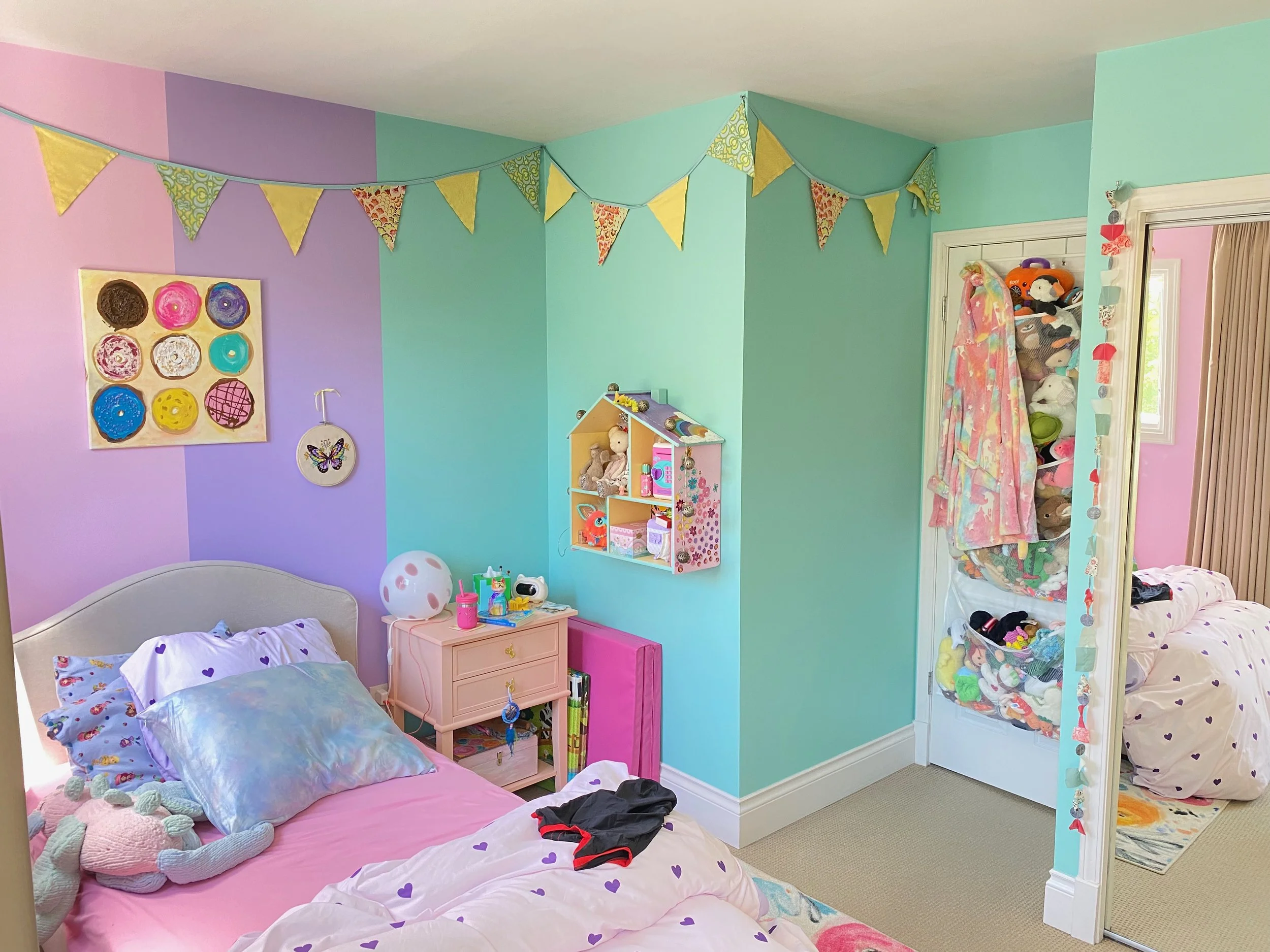
Colourful child’s bedroom painted in turquoise, lavender and pink with multiple feature walls.
A child’s bedroom is one of the few rooms in a home that is almost guaranteed to keep changing.
It might begin as a nursery, designed before its occupant has even arrived. A few years later there are favourite colours, animals, planets, princesses, dinosaurs or whatever else has taken over their imagination. Eventually, that child has very definite ideas of their own.
Paint is particularly good for this kind of room because it doesn’t have to be permanent. A bedroom can change as the kid does.
And there are a lot more possibilities than simply choosing one colour and painting all four walls.
Starting With the Nursery
When preparing a nursery, people often gravitate toward soft colours — warm whites, pale greens, muted pinks, blues and neutrals. There’s nothing wrong with that, but a nursery doesn’t necessarily need to look like a nursery catalogue.
A coloured ceiling, a feature wall, a painted arch behind the crib, or two coordinating colours can give the room much more character without making it busy.
Paint choice can matter here as well. Low-odour, zero-VOC and zero-emissions paints are available for people who want to minimize paint fumes and emissions in a nursery or newly occupied room.
“Low VOC,” “zero VOC,” “low odour” and “zero emissions” don’t all mean exactly the same thing, so we can help choose a product based on what matters most for the particular room.
Then They Develop Opinions
This is where children’s bedrooms get more interesting.
Once a child starts choosing their own colours, the answer doesn’t have to be either “no” or four walls of radioactive purple.
A favourite colour can be used in dozens of ways.
A single feature wall is the simplest. But you can also use broad horizontal bands, vertical stripes, colour blocking, geometric shapes, painted arches or a darker colour on the lower half of the wall.
Doors, closets, bookshelves and other built-ins can become accents too.
And don’t forget the ceiling. A child’s bedroom is one of the few places where a blue, pink, yellow or even very dark ceiling can make perfect sense.
Sometimes the slightly strange colour combination a kid comes up with turns out to be much more interesting than the tasteful adult version.
[PHOTO: colourful turquoise, lavender and pink bedroom]
There’s no rule saying a bedroom has to be one colour. In this room, several strong colours work together because they’re given their own areas rather than being mixed everywhere at once.
Paint That Actually Does Something
There are also specialty paints that can turn part of the room into something interactive.
Chalkboard paint can create a drawing surface on a wall, door or smaller panel.
Magnetic paint contains iron particles that allow magnets to stick to the painted surface. A normal wall colour can usually be painted over it, so the magnetic wall doesn’t have to look different from the rest of the room.
And yes, there is glow-in-the-dark paint.
It can be used for stars on a ceiling, constellations, planets, shapes, lettering or small details that disappear during the day and show up when the lights go out.
For a kid, that is considerably more exciting than discussing the relative merits of eggshell and matte.
Choosing a Paint Finish for a Kid’s Room
The finish — or sheen — affects both how the paint looks and how easily it can be cleaned.
In general, the shinier a paint is, the more resistant it is to washing and repeated cleaning. Satin and eggshell finishes have traditionally been popular for children’s rooms for that reason.
Modern paints have changed things somewhat. Some high-quality matte and low-sheen paints are now surprisingly washable, so you don’t necessarily need shiny walls simply because there is a child living between them.
Higher sheen also reflects more light and tends to show bumps, patches and imperfections more clearly.
For many kids’ bedrooms, eggshell is still a very practical middle ground: enough durability for fingerprints and marks without looking glossy.
Trim, doors and baseboards are generally painted in a more durable finish such as satin or semi-gloss.
Small Rooms Don’t Have to Be White
This is particularly relevant in Vancouver, where children’s bedrooms are often not enormous.
There’s a persistent idea that small rooms need to be painted white or very pale colours to make them look bigger. Sometimes that works. But a small room can also benefit from embracing its size.
A deeper colour can make a little bedroom feel cosy and deliberate. Painting a wall and ceiling the same colour can soften awkward angles. Vertical colour blocks can emphasize height. A contrasting end wall can change the apparent proportions of a long narrow room.
Older Vancouver homes also tend to have architectural details that newer homes don’t — picture rails, sloped ceilings, unusual alcoves, built-in cupboards and interesting trim. Instead of treating those features as obstacles, paint can emphasize them.
A Room That Can Keep Changing
One advantage of using paint rather than committing everything to wallpaper, permanent fixtures or an elaborate theme is that the room can evolve fairly easily.
The dinosaur years end.
So do the princess years.
Then apparently everything needs to be black.
Paint can keep up.
A child’s bedroom doesn’t need to be sophisticated enough for the adults in the house. It needs to belong to the person who sleeps there.
And because paint is relatively easy to change, it’s a good place to experiment a little.
Thinking about painting a nursery or kid’s bedroom in Vancouver?
Port City Painting can help with everything from colour placement and feature walls to washable finishes, specialty paints, and low-odour or zero-emission options.